
Desk Notes No.38
Sargent’s American Heiresses, Henry James, and The Portrait of a Lady

Dear friends,
Fashion photographer and artist, Cecil Beaton, was devastated when the lease expired on his country residence at Ashcombe House in Wiltshire. The garden at Ashcombe had been much neglected on his arrival in 1930, and Beaton set to work improving the soil, clearing weeds, and acquiring plants and bulbs from nursery catalogues. He had little gardening experience and was learning on the job. For fifteen years, Ashcombe became not only a place to host weekend parties but a necessary escape from the demands of work. Wandering through the exhibition at Lambeth’s Garden Museum, which explores how Beaton’s gardens informed his art, I reflected on my own gardening journey, transforming a suburban lawn plot and ivy strewn fences into a relaxing shelter for flowers and vegetables. It is in an ongoing project that evolves with each year. When I look to the future, it is the garden that makes me feel rooted to this place; the years of hard work, the familiar blooms that rise from the soil to greet me every spring.
I haven’t written in a while, but it’s been a surprising summer in the garden. The near perpetual heatwave has helped me to succeed with peppers and aubergines for the very first time. Still ripening on the bushes, I am hopeful the fruits will be ready before autumn sets in. The freezer is bursting with tomato sauce and roasted courgettes, while raspberry bushes have managed to fruit in the shade. Winter squashes are already gloriously orange on the climbing frame. Gardens are fickle things and I don’t expect to have similar success again, but I’m enjoying the abundance while it lasts.
Places
Heiress: Sargent’s American Portraits at Kenwood House, London, until 5 October 2025
When Julian Fellowes made the future of Downton Abbey dependent upon the Earl of Grantham’s marriage to a wealthy American heiress, he pulled on a long and tangled thread in the British public consciousness. Now Fellowes has crossed the Atlantic to follow the lives of rich New York women in The Gilded Age. And Apple have jumped on the bandwagon too, with an adaptation of Edith Wharton’s unfinished novel, The Buccaneers, about American heiresses in London. But we need look no further than Wallis Simpson and Meghan Markle to witness Britain’s uncomfortable relationship with American women marrying into the aristocracy.
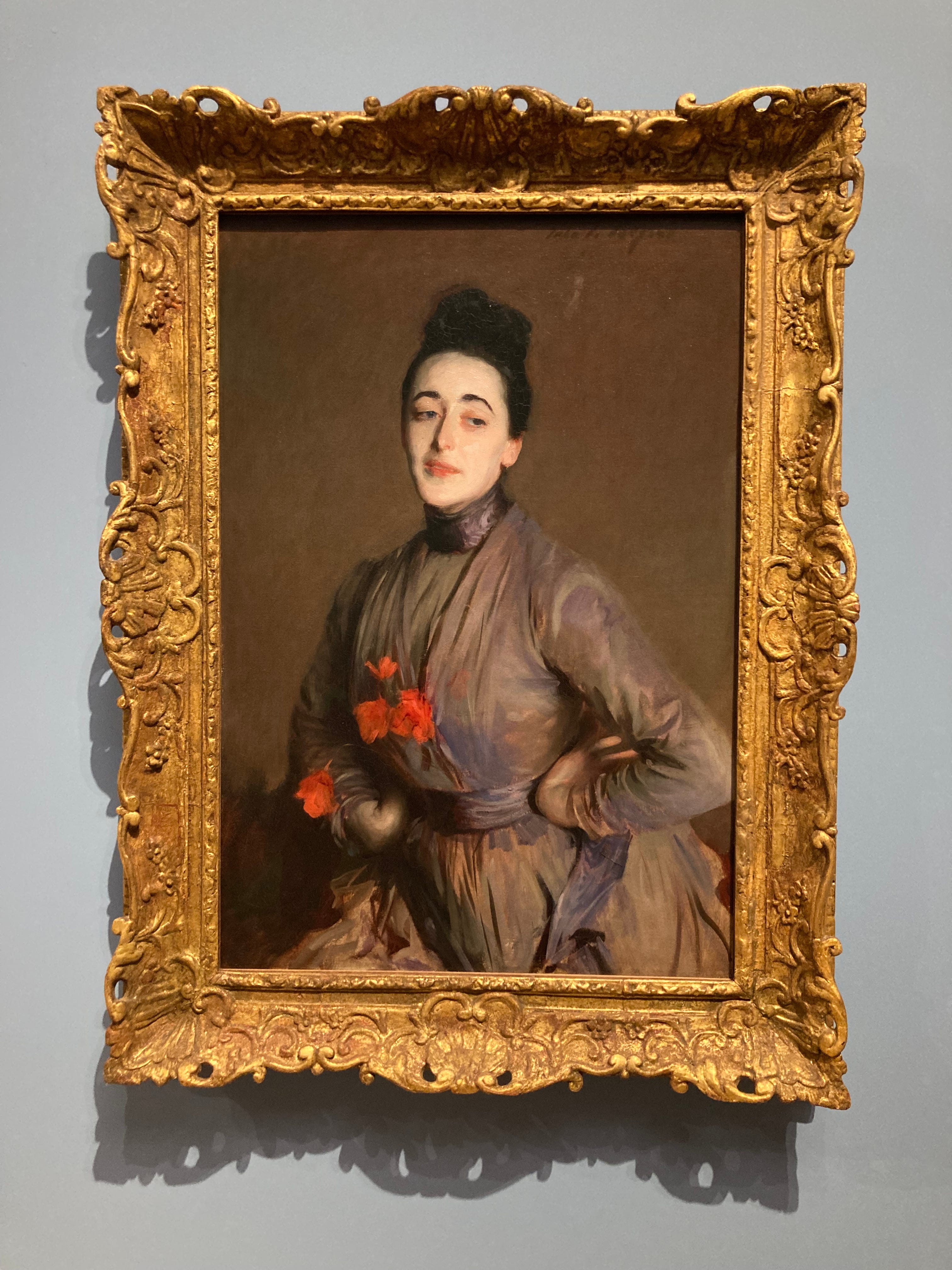
A new exhibition at Kenwood House in Hampstead tells us that “between 1870 and 1914, 102 American women married into the British peerage, and many more into the upper classes.” These women were often unfairly maligned and stereotyped, their marriages perceived as, “an exchange of money for titles.” More than thirty of these American heiresses were painted by John Singer Sargent. Drenched in Sargent’s style — sumptuously bathed in silks and pearls — their identities blurred and assimilated. They became the ‘dollar princesses’. Now Heiress endeavours to return the female power inadvertently stolen by Sargent’s glamorising oils.
Painted shortly after their marriages, what strikes is the youth and beauty of the women here. I wrote about the seductive glamour of Sargent’s portraits when they were exhibited at Tate last year, seeing them as a precursor to modern fashion photography. Arrayed here under the banner of wealth and social ambition I felt a little differently. Undoubtedly the pictures reveal women stepping into their power. Hung high on the wall, the women in these dramatic full length oil portraits look down upon us; something a little uppity in their eye, self-congratulating perhaps. And yet there remains something uncomfortable, almost repulsive about the idea of these women decked out and posed for the male gaze; the trophies of entitled men. The experience is both beautiful and nauseating. In the 1970s John Berger wrote that, “Glamour cannot exist without personal social envy being a common widespread emotion.” This was, it seems, something John Singer Sargent already understood.
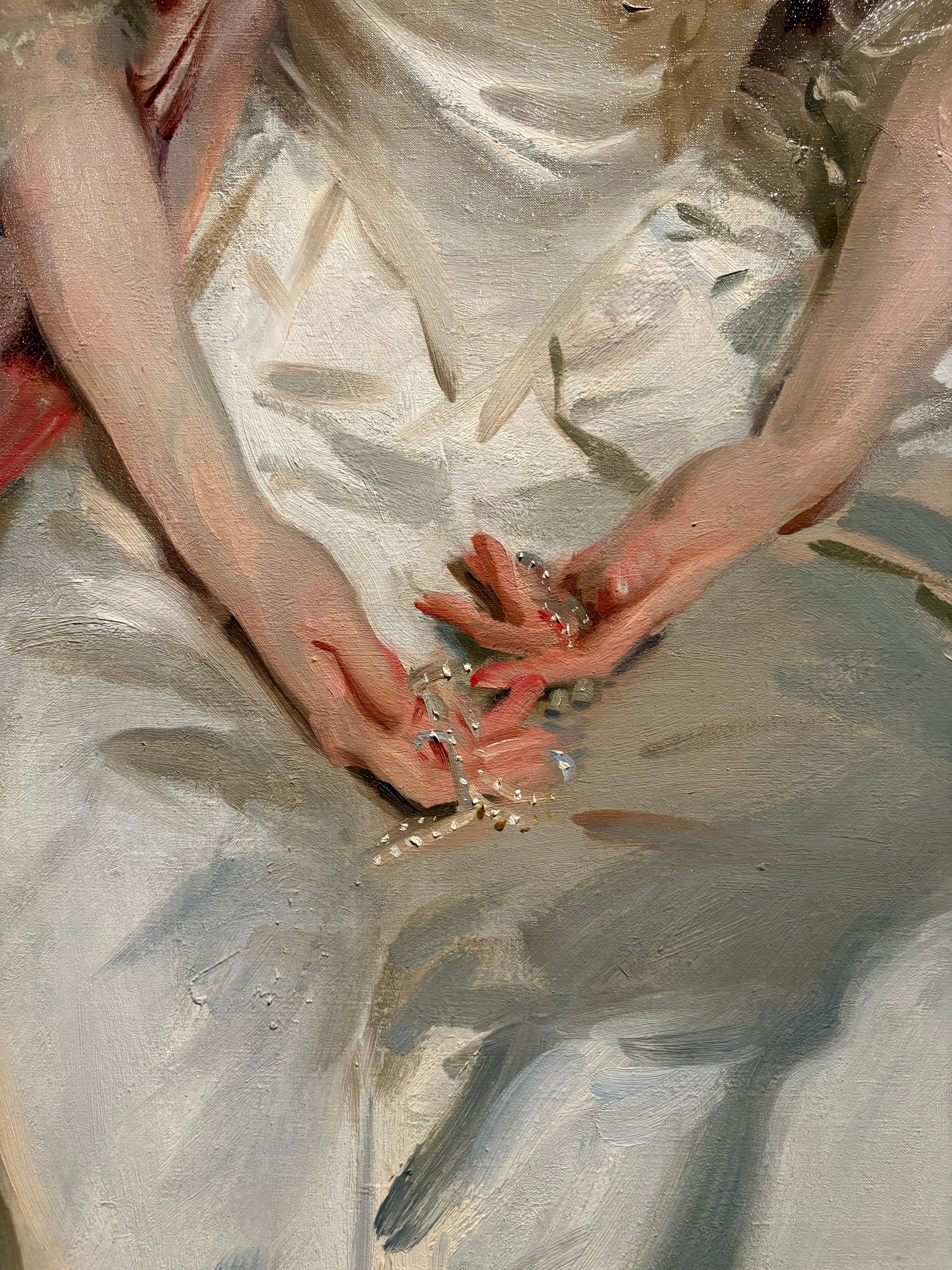
At twenty-nine, recently married to Waldorf Astor, Nancy Astor glances over her bare left shoulder, a peach silk ribbon cascading from a pinched waist, softly grazing her hands. The picture is dazzling, seductive, sexy. “My vigour, vitality, and cheek repel me,” Nancy was quoted in the Evening Star, “I am the kind of woman I would run from.” Nancy was not rich, in fact she had been married once before and divorced in 1903. She became the first woman to sit as a Member of Parliament and campaigned to ban the sale of alcohol to under eighteens. She was the very antithesis of a ‘dollar princess’. Another portrait in charcoal, fifteen years later, shows an entirely different Nancy whose coquettish flirtation has been replaced with straightforward confidence. She demands we take her seriously.
It is in Sargent’s charcoal portraits and preparatory sketches that we glimpse more of the real women behind the stereotype. And it is in the exhibition’s text where we find a real and considered challenge to the ‘dollar princess’ slur. Take the tragedy of Consuelo Vanderbilt’s marriage to the Duke of Marlborough.
“The duke effectively told her on their honeymoon that he had wed her only to save Blenheim Palace, his ducal seat. A difficult, fairly loveless marriage ensued, which failed in private by 1906 and in public by 1921.”
With just a whisper of hair and a suggestion of pearls, Sargent’s sketch allows us to see through the noise. Raised brows and wide eyes exude both softness and curiosity, while perfect, pert lips seem to hold something back. After her divorce and remarriage, Consuelo would find her voice writing an autobiography, The Glitter and the Gold, becoming a County Councillor for Southwark, and helping to introduce a minimum wage for women in the ‘sweated’ trades which were characterised by long hours, poor conditions, and piece-work.
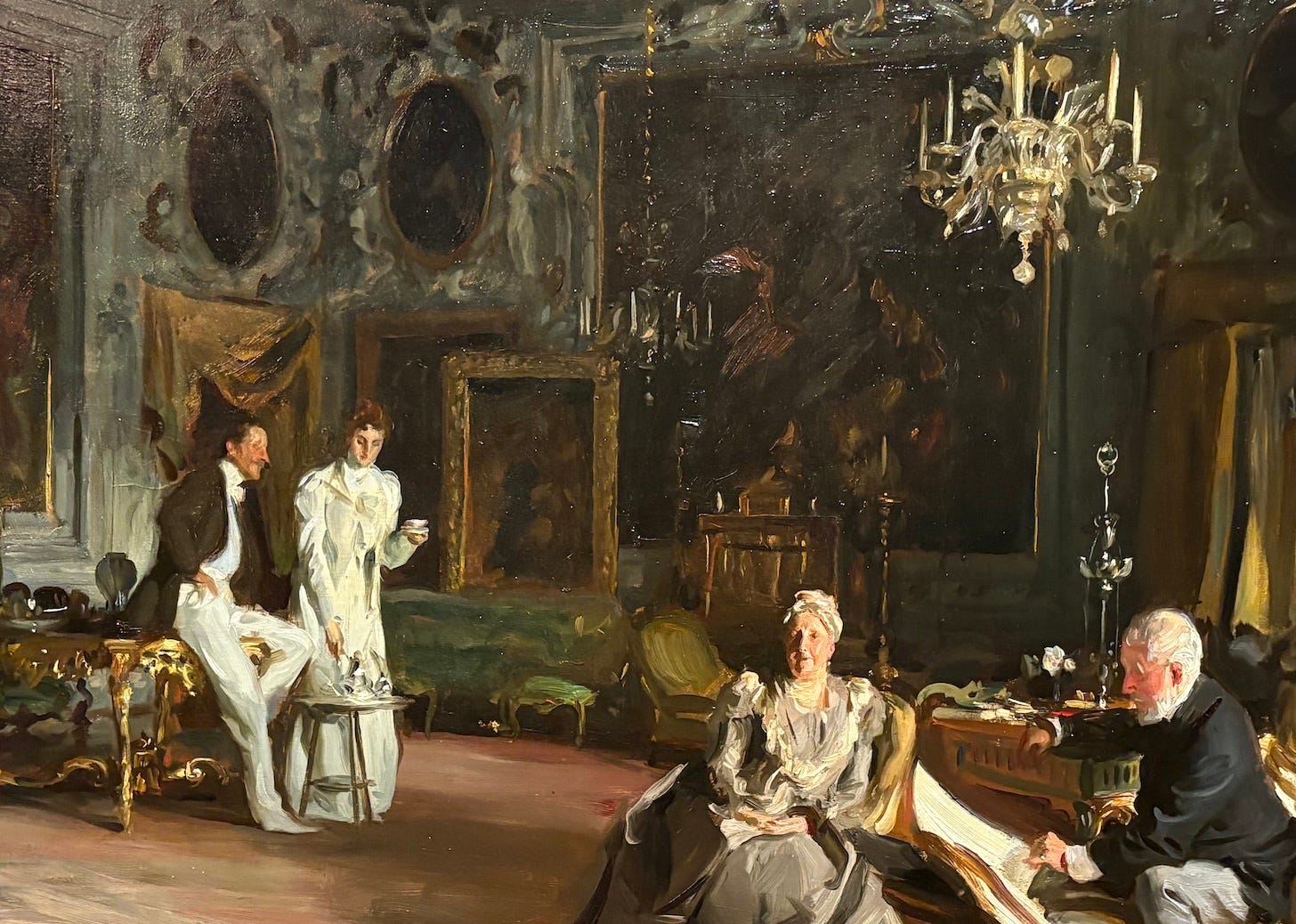
What bleeds through the stories, and yet remains curiously out of view, is the tragedy that these women, with their independent wealth, needed to marry at all. Nestled among the pictures is a scene that could come from a Forster novel, or a Henry James. The older generation sits occupied in the foreground, while a young man and woman, dressed in an effortlessly chic white gown, talk amiably in the back. Relaxed and confident, the young man casually leans against a gilt-legged table, hand on hip, one foot on the ground, while she, reserved and genteel, pours tea from a silver pot. The young woman is, in fact, Lisa Curtis who married not, “into the British aristocracy but rather into the cosmopolitan, artistic American milieu.” And yet, to me at least, the scene speaks of generational social ambition — of the role parents once played in moulding and manipulating their children’s social destiny.
Print
The Portrait of a Lady by Henry James, first published in 1881
“I thought she was meant for something better. It occurred to me that it would be a kindness to take her about and introduce her to the world. She thinks she knows a great deal of it—like most American girls; but like most American girls she is very much mistaken.”
“A man might marry a woman for her money, very well; the thing was often done. But at least he should let her know!”
While a wave of American heiresses were marrying into the aristocracy, Henry James was writing about American ex-pats in Europe. In perhaps his most famous novel, The Portrait of Lady, James gives us Isabel Archer, an independent spirit from New York brought to Europe by her Aunt. Isabel wants to see life, through her own eyes, as an independent woman. With little financial means she refuses numerous offers of marriage, valuing her freedom above all else. When she inherits a large sum from her uncle’s estate — a secret request of his son and heir, Ralph, who wishes to finance Isabel’s independent imagination — she becomes vulnerable prey. The great tragedy of the novel is that Isabel makes her own free choice to marry, choosing the man she likes most. When it becomes a claustrophobic disappointment, Isabel believes she has no one else to blame.
“Nothing was a pleasure to her now; how could anything be a pleasure to a woman who knew that she had thrown away her life?”
Readers of the novel may believe otherwise. James gives us a sweeping panorama of different perspectives. It soon becomes clear the men in Isabel’s orbit view her only through the lens of their own desire. To be independent as a woman is not enough. The novel teaches us that a woman must also be immune to even the subtlest kinds of manipulation — something which would mean foregoing the very things that make us human.
“I had treated myself to a charming vision of your future,” Ralph observed without answering this; “I had amused myself with planning out a high destiny for you. There was to be nothing of this sort in it. You were not to come down so easily or so soon.”
“Come down, you say?”
“Well, that renders my sense of what has happened to you. You seemed to me to be soaring far up in the blue—to be, sailing in the bright light, over the heads of men. Suddenly some one tosses up a faded rosebud—a missile that should never have reached you—and straight you drop to the ground. It hurts me,” said Ralph audaciously, “hurts me as if I had fallen myself!”
The look of pain and bewilderment deepened in his companion’s face. “I don’t understand you in the least,” she repeated. “You say you amused yourself with a project for my career—I don’t understand that. Don’t amuse yourself too much, or I shall think you’re doing it at my expense.”
By opening the novel with not one but two marriage proposals, James points to the heart of the problem — a woman’s lack of agency in Victorian culture. As a woman, Isabel is only ever required to answer the marriage question, she can never ask it. This unnatural position feeds the male expectation of her as submissive, passive, and under their control. When Isabel defies their expectations, they don’t know how to channel their frustration or desire, and she is left suffocated and conscience-stricken. Nevertheless she asserts her own sense of self.
“We see our lives from our own point of view; that is the privilege of the weakest and humblest of us; and I shall never be able to see mine in the manner you proposed.”
When Isabel eventually decides to marry, it is based on a thorough misunderstanding of her future husband’s character. On her arrival in Europe Isabel quickly learns the impropriety of being alone in rooms with men — the Victorian marriage system is set up in such a way that prospective couples never truly know each other. “I don’t know you,” she says to two failed suitors. In marriage, both Isabel and her husband find themselves living with someone who falls short of their expectations, someone they feel themselves growing to hate.
“He was not changed; he had not disguised himself, during the year of his courtship, any more than she. But she had seen only half his nature then, as one saw the disk of the moon when it was partly masked by the shadow of the earth. She saw the full moon now—she saw the whole man.”
These passages put me in mind of another recent read, George Eliot’s Middlemarch. Eliot explores how the attraction between the prospective couples in her novel — Rosamund and Lydgate, Dorothea and Casaubon — are based on half-imagined versions of each other. When they finally come to know each other, it is too late — they must adjust expectations, must compromise, sacrifice, and muddle through. For Rosamund and Lydgate this involves the death of love; death even, of aspects of the self. Both of these novels — Middlemarch and The Portrait of a Lady — are difficult, heavy reads, in part because they feel more honest about the reality of marriage for women at the time; more realistic than the more prolific and uplifting marriage plot romances including Pride & Prejudice, to Jane Eyre, and North & South.
By the end of the novel Isabel is trapped, not only by Victorian marriage laws and the importance of propriety, but by her own idea of a woman’s duty to her husband. Indeed, the novel is very telling about the unreasonable expectations placed upon women and the ways in which these ideas become embedded in the female consciousness, even against a woman’s better judgement.
“He was not one of the best husbands; but that didn’t alter the case. Certain obligations were involved in the very fact of marriage, and were quite independent of the quantity of enjoyment extracted from it.”
That Isabel consigns herself to this terrible future in order to protect her submissive step-daughter from a similar fate is, perhaps, the most beautiful part of the novel.
Thank you so much for taking the time to read this post, your support means a lot. If you enjoyed this newsletter please share it with your friends, or subscribe to get future editions direct to your inbox.
Keep reading:
This month’s featured image is ‘An Interior in Venice’, 1899, by John Singer Sargent. My photo taken at Kenwood House. Banners are courtesy of the Internet Book Archive.
Of Henry James I've only read his The Turn of the Screw, but your review and the excerpts you've chosen to illustrate your point of view really made me feel for Isabel. Though the writing seems good, the plot sounds uncomfortable. And its sad that women from my mother's generation (born 1954) worked hard to live up to expectations of a wife that they had never agreed upon, but felt they had to live up to.
This, for me, is such a great weaving of soil, silk, and story. Lovely piece.